
Can You Airbnb Your Backyard ADU in NYC? What Short-Term Rental Laws Mean for ADU Owners
It is one of the first questions NYC homeowners ask when they learn about backyard ADUs: can I list it on Airbnb? The appeal is obvious. A detached backyard unit with its own kitchen, bathroom, and entrance seems tailor-made for short-term guests. And with nightly Airbnb rates in NYC averaging $150 to $200 or more, the income potential looks hard to pass up.
The short answer: no. You cannot legally operate a short-term rental in your backyard ADU in New York City. NYC has some of the strictest short-term rental laws in the country, and backyard ADUs built under City of Yes are not exempt.
But the legal alternatives, particularly furnished monthly rentals, may actually be more profitable and far less work than Airbnb ever was. This post explains the law, why ADUs specifically cannot qualify, and how to structure your rental strategy around what is legal and proven. For a full overview of ADU rules and eligibility, see our NYC Homeowner’s Guide to Detached Backyard ADUs.
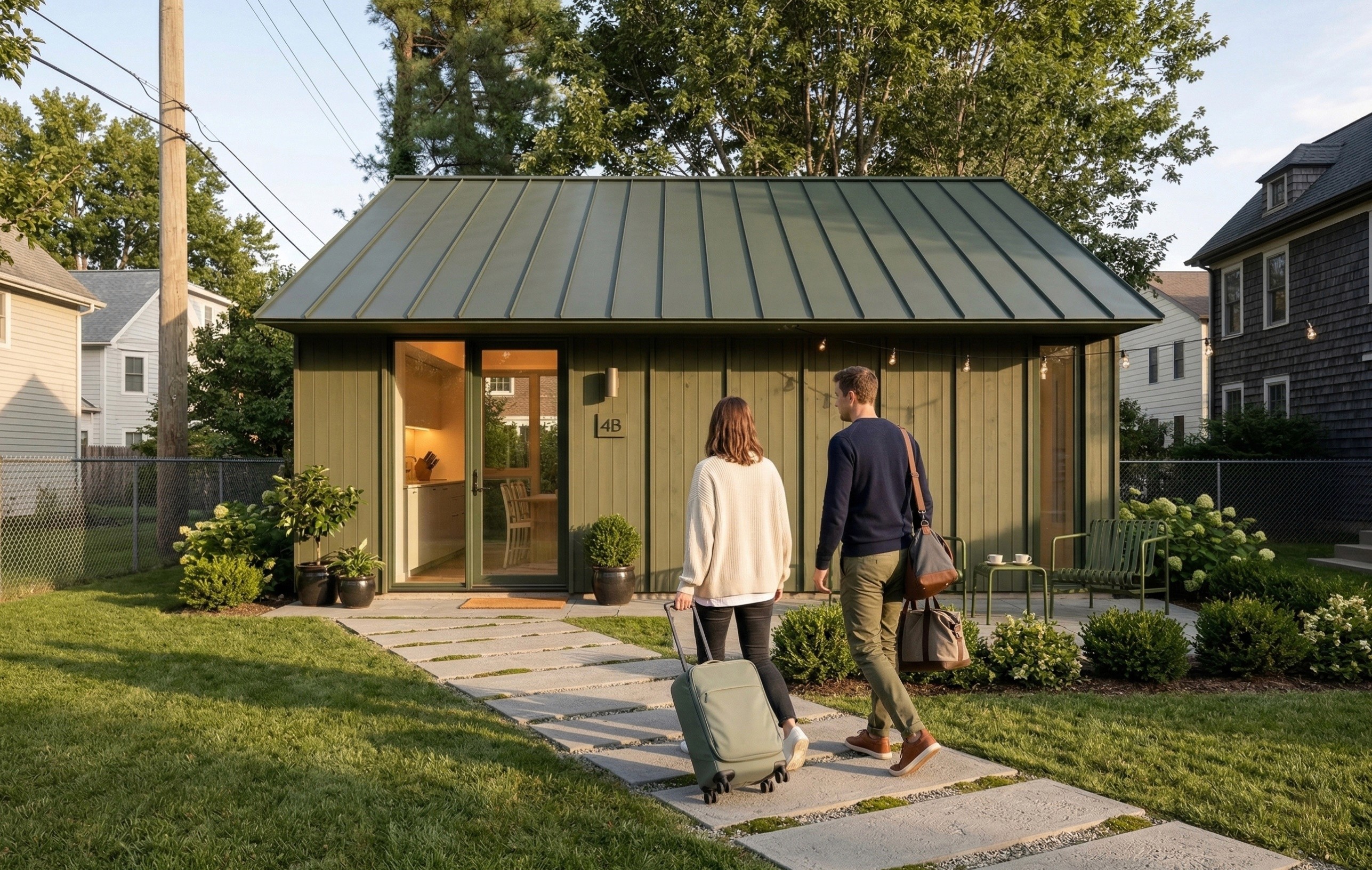
A Haven ADU in a backyard setting. Under NYC law, units like this cannot be used as short-term rentals but are fully legal for 30+ day furnished monthly rentals.
NYC’s Short-Term Rental Law: Local Law 18
In September 2023, New York City began enforcing Local Law 18 (LL18), officially known as the Short-Term Rental Registration Law. The law had been signed in January 2022, but full enforcement, including mandatory registration and platform verification, took effect on September 5, 2023. It fundamentally changed the legal landscape for platforms like Airbnb, Vrbo, and Booking.com in NYC.
What Local Law 18 Requires
Local Law 18: Key Requirements 1. All short-term rentals (stays under 30 days) must be registered with the Mayor’s Office of Special Enforcement (OSE). 2. The host must be the permanent resident of the dwelling and must be physically present during the guest’s stay. 3. No more than two guests are allowed at a time. 4. The entire unit cannot be rented out. Guests must share the space with the host. 5. Booking platforms are prohibited from processing transactions for unregistered listings. |
The result has been dramatic. According to reporting from multiple outlets, the number of active Airbnb listings in NYC dropped by more than 80% after LL18 took effect, falling from roughly 22,000 listings in August 2023 to around 4,000 by mid-2024. Outer boroughs were hit especially hard, with listings dropping from about 17,000 to 1,400.
Why Your Backyard ADU Cannot Be a Short-Term Rental
Even if you wanted to navigate LL18’s registration process, a detached backyard ADU cannot qualify. There are three reasons.
You cannot be present in both structures. LL18 requires the host to be physically present during the stay. Your ADU is a separate, detached structure from your main house. You are not sharing the unit with your guest, so the physical presence requirement cannot be met.
The ADU is a separate dwelling. Under City of Yes rules, a detached backyard ADU is its own self-contained dwelling unit with its own kitchen, bathroom, and entrance. LL18’s requirement that guests share the host’s dwelling makes this a non-starter.
Occupancy rules apply. ADUs built under City of Yes are subject to the same housing regulations as any other dwelling in NYC. They are designed for residential occupancy, not transient hospitality.
Penalties for Illegal Short-Term Rentals in NYC Listing a backyard ADU as a short-term rental on Airbnb or any similar platform is illegal under current NYC law. Violations carry penalties of up to $5,000 per offense, plus up to three times the revenue collected from the illegal rental. The Mayor’s Office of Special Enforcement actively monitors platforms and investigates complaints. |
The Legal Alternative: Furnished Monthly Rentals (30+ Days)
The 30-Day Threshold Rentals of 30 days or more are NOT subject to Local Law 18. Your backyard ADU can be rented to tenants on month-to-month leases, standard one-year leases, or furnished monthly rentals with no registration requirement and no platform restrictions. |
This is not a consolation prize. For most homeowners, furnished monthly rentals are the better business model.
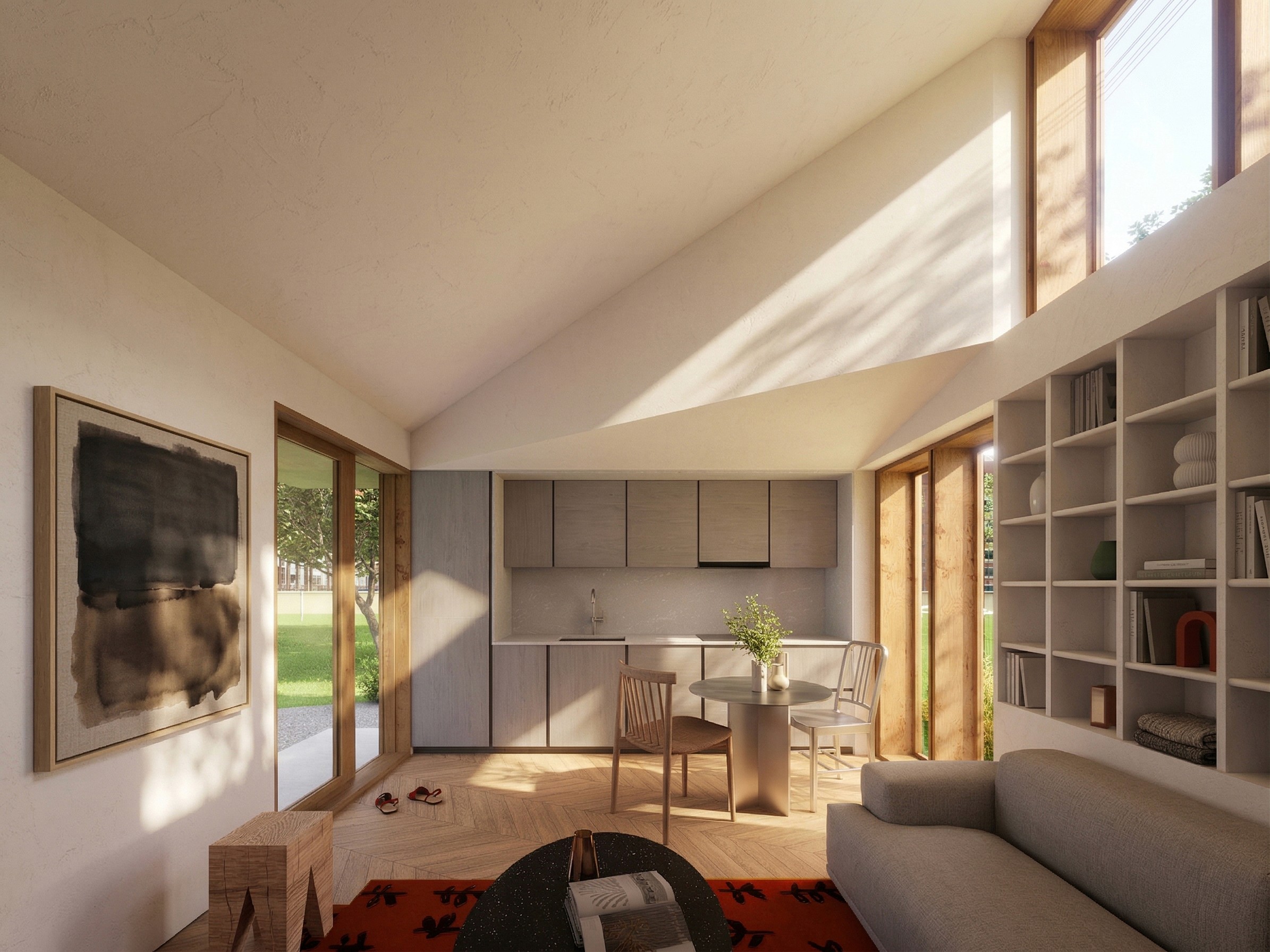
Interior of a Haven ADU. Cathedral ceilings, herringbone floors, and full kitchen make this a premium furnished monthly rental product.
Why Furnished Monthly Rentals Beat Airbnb for ADU Owners
Consistent income. Airbnb income fluctuates with seasons, reviews, and competition. A furnished monthly rental at $2,200 to $3,500 per month in many NYC neighborhoods provides reliable, predictable cash flow.
Lower operating costs. No cleaning fees between stays, no restocking supplies, no managing check-ins and check-outs, no professional photography, no response-time pressure from the platform.
Less wear and tear. Monthly tenants treat a space more carefully than rotating short-term guests. Your ADU stays in better condition longer.
No platform fees. Airbnb takes 3% from hosts (and up to 14% from guests). Furnished monthly rentals booked directly or through platforms like Furnished Finder or Zillow keep more money in your pocket.
Simpler tax situation. Standard rental income reporting versus the complicated tax implications of operating a hospitality business.
Legal certainty. Zero regulatory risk. No registration, no inspections, no fines. You are a landlord, not a hotelier.
Income Comparison: Airbnb vs. Furnished Monthly Rental
Here is how the actual economics compare for a backyard ADU in a typical NYC neighborhood. The Airbnb column is hypothetical because it is not legal for a detached ADU, but the comparison illustrates why monthly rentals hold up well even against the best-case Airbnb scenario.
| Airbnb (Hypothetical) | Furnished Monthly |
Rate | $175/night | $2,800/month |
Occupancy | 65% (NYC avg) | 95% (1 mo vacancy/yr) |
Gross Annual | $41,500 | $31,920 |
Platform Fees | -$4,150 (3-14%) | $0 (direct) |
Cleaning/Supplies | -$5,200 | -$500 |
Furnishing Refresh | -$2,000 | -$800 |
Management Time | 15-20 hrs/week | 2-4 hrs/month |
Net Annual Income | ~$30,150 | ~$30,620 |
Hourly Equivalent | ~$30/hr of work | ~$640/hr of work |
Legal in NYC? | No (backyard ADU) | Yes |
The net annual income is nearly identical. But the Airbnb scenario requires 15 to 20 hours per week of active management, while the furnished monthly model takes 2 to 4 hours per month. On a per-hour basis, furnished monthly rentals are dramatically more efficient.
Who Rents Furnished Monthly Units in NYC?
There is a robust and growing market for furnished monthly rentals in New York City. This is not a niche. NYC’s status as a global city with major hospitals, universities, and corporate headquarters means there is always someone looking for a furnished monthly unit.
Common Furnished Monthly Tenants Travel nurses and healthcare professionals on 13-week rotations Corporate employees on temporary assignments or relocations Graduate students, postdocs, and visiting researchers Remote workers spending a season in NYC People between apartments (renovations, sales closings, lease gaps) Families visiting for extended medical care |
Where to List Your ADU for Monthly Rentals
Furnished Finder. Originally built for travel nurses, now the go-to platform for furnished monthly rentals nationwide. No booking fees for landlords.
Zillow and Apartments.com. Standard rental platforms that allow you to specify furnished and monthly terms.
Facebook Marketplace and local groups. Surprisingly effective for finding quality tenants, especially in neighborhood-specific groups.
Direct referrals. Once you have had a few good tenants, word-of-mouth and repeat bookings often fill vacancies without any platform.
Not Just Detached: Four ADU Types to Consider
This post focuses on detached backyard ADUs because they are the most common type homeowners ask about in the context of Airbnb. But NYC’s City of Yes rules allow four structural ADU types, and each one is fully legal for 30+ day rentals.
Four Structural ADU Types Under City of Yes Garage Conversion: Convert an existing garage into a livable unit without changing the footprint. Simplest permitting path. Garage Demo and Rebuild: Demolish an existing garage and build a new, larger ADU in its place. Often yields the largest unit. Attached Addition: Build an addition that connects directly to your existing home. Lower construction cost, shared walls. Detached Backyard Unit: A standalone building in your backyard. Most privacy and flexibility, but the most zoning checks. |
Many homeowners who cannot accommodate a detached unit still have excellent options. A garage conversion or attached addition can produce the same rental income with a simpler permitting path and lower construction cost. Haven’s free feasibility tool at havenadus.com/eligibility evaluates your property for all four types, with site plans, eligibility checks, and maximum sizes for each option.
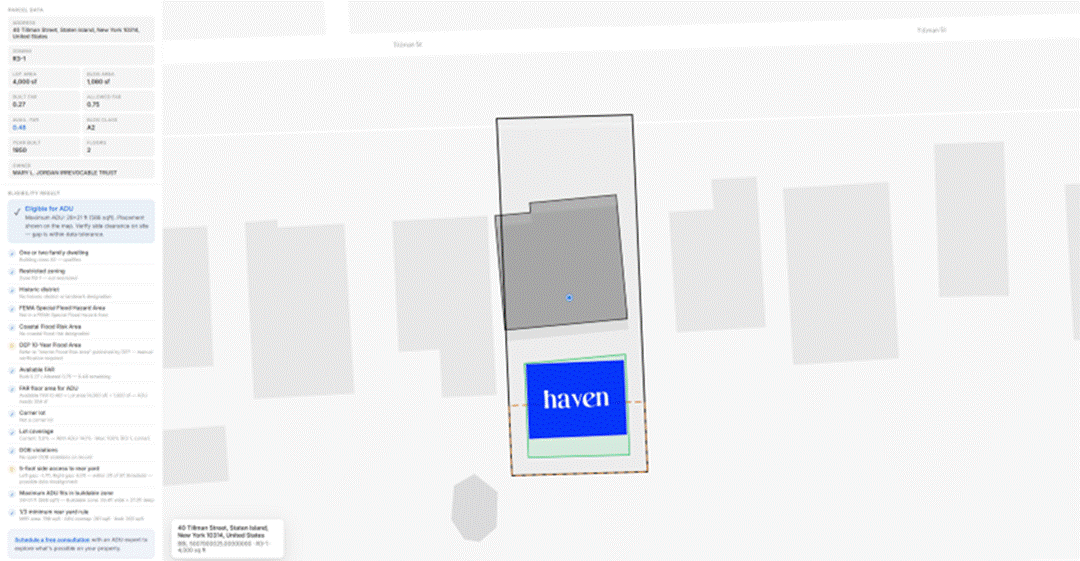
Haven’s free ADU feasibility tool evaluates your property for all four ADU types, with site plans and eligibility checks for each.
Legal Checklist for Renting Your NYC Backyard ADU
Before you list your ADU for rent, make sure you have the following in place.
Certificate of Occupancy. Your ADU must have a valid CO from the NYC Department of Buildings. This is issued after construction is complete and inspected.
Lease agreement. Use a standard NYC residential lease for 30+ day rentals. For furnished monthly rentals, specify the furniture inventory and any additional terms.
HPD landlord registration. Register with HPD as required for all NYC rental properties.
Insurance coverage. Update your homeowner’s insurance to include the rental ADU, or obtain a separate landlord policy. Standard homeowner’s policies typically do not cover rental units.
Lead paint disclosure. Required for buildings built before 1978. New ADU construction is exempt since the structure is brand new.
Rent stabilization check. New ADU construction is generally exempt from rent stabilization, but confirm with a housing attorney if you have questions.
Financing Your ADU: The Plus One ADU Program
Plus One ADU Program (Reopened March 2026) New York State’s Plus One ADU Program now offers up to $395,000 in combined low-interest and no-interest loans and grants for eligible homeowners building ADUs. Application deadline: June 12, 2026 Income eligibility: Household income up to 165% of area median income More info: hcr.ny.gov/adu |
This is a significant expansion from the earlier version of the program. If you are planning an ADU project, check current eligibility and terms at hcr.ny.gov/adu. Haven can help you navigate the application process as part of our design-build service.
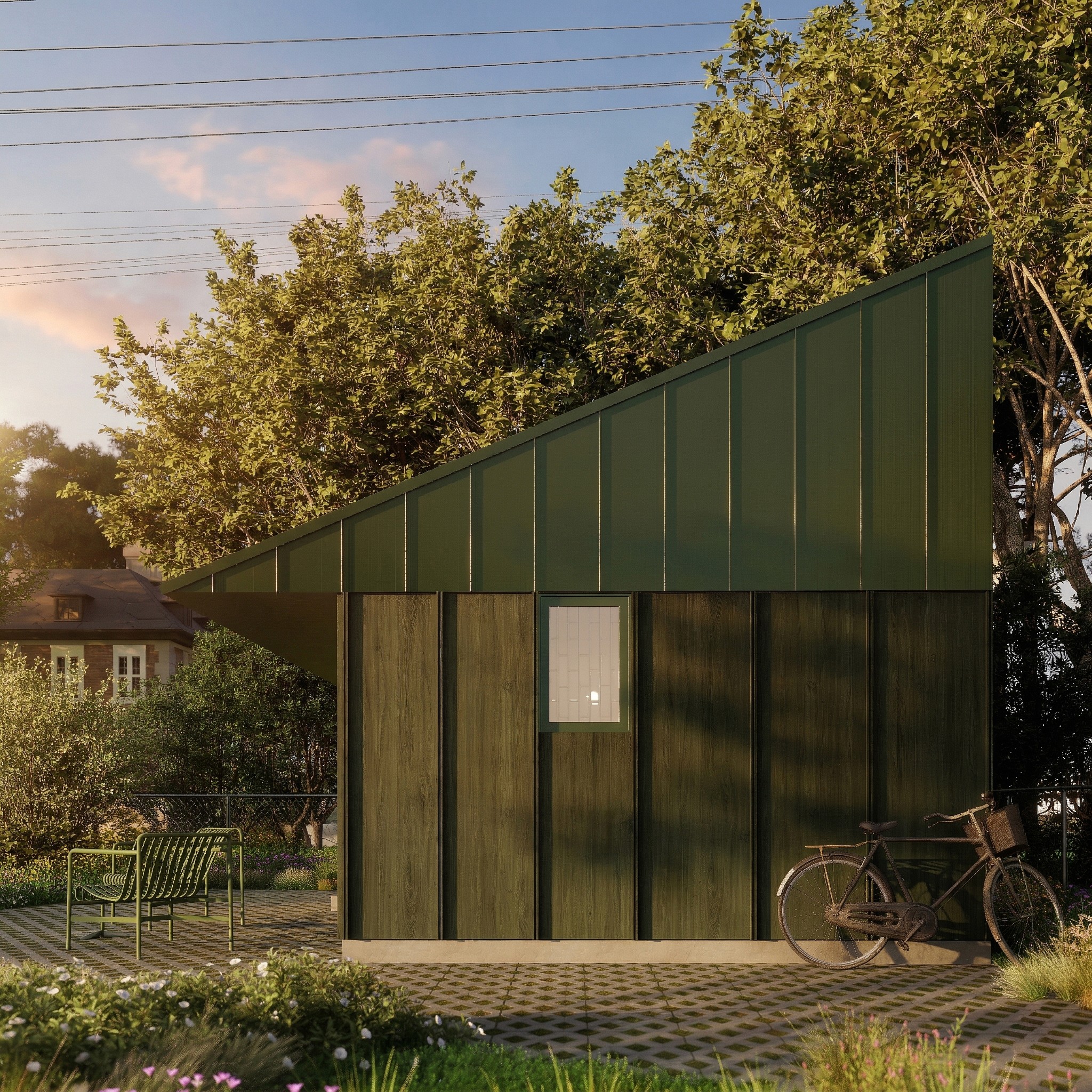
The Haven Studio: a self-contained backyard ADU designed for NYC lots, fully legal for monthly rentals.
Could NYC Allow Short-Term Rentals in ADUs in the Future?
It is possible but unlikely in the near term. Local Law 18 has strong political support from housing advocates, hotel unions, and a City Council that views unregulated short-term rentals as a contributor to the housing crisis. The law survived legal challenges from Airbnb, and enforcement has only strengthened since 2023.
There are pending bills in the NYC Council (including Int 0948-2024 and Int 1107-2024) that would create limited short-term rental pathways, but as of April 2026, none have advanced out of committee. If such a provision were ever adopted, it would likely come with strict caps on the number of nights per year and a registration requirement.
For now, the safest and smartest strategy is to plan your ADU around the rental model that is legal, proven, and profitable: furnished monthly rentals of 30 days or more.
The Bottom Line
No, you cannot Airbnb your backyard ADU in NYC. Local Law 18 makes short-term rentals in a detached ADU illegal. Violations carry penalties of up to $5,000 per offense plus three times the illegal revenue collected. But furnished monthly rentals are fully legal, require a fraction of the management effort, and generate comparable income with none of the regulatory risk.
The homeowners who will do best with their backyard ADUs are those who design for livability, price for the monthly market, and treat the ADU as a long-term asset rather than a quick hustle.
Ready to explore your ADU options? Check your property for all four ADU types with Haven’s free feasibility tool at havenadus.com/eligibility. Or call (917) 938-7864 to discuss your rental strategy. |
Frequently Asked Questions
Can I list my backyard ADU on Airbnb for stays under 30 days?
No. NYC’s Local Law 18 requires short-term rental hosts to be physically present in the same dwelling as the guest. Since a detached ADU is a separate structure, this requirement cannot be met. Violations carry penalties of up to $5,000 per offense plus three times the revenue from the illegal rental.
What about Vrbo, Booking.com, or other platforms?
The same rules apply. All short-term rental platforms operating in NYC are required to verify registration before processing bookings. An unregistered detached ADU cannot be listed on any platform for stays under 30 days.
Can I rent my ADU for exactly 30 days?
Yes. Rentals of 30 days or more are not subject to Local Law 18. There is no upper limit. You can rent month-to-month, seasonally, or on a standard annual lease.
How much rental income can a backyard ADU generate in NYC?
Depending on your borough and neighborhood, a furnished backyard ADU can rent for $2,200 to $3,500 per month. In Astoria, Queens, a furnished studio averages around $2,400 to $2,800 per month. Higher-end finishes and desirable locations command the top of that range. Annual net income after expenses typically falls between $19,000 and $30,000.
Do I need a special license to rent my ADU on a monthly basis?
No special license is required for rentals of 30 or more days. You will need a valid Certificate of Occupancy for the ADU, landlord registration with HPD, and appropriate insurance coverage.
What is the Plus One ADU Program?
The Plus One ADU Program is a New York State financing program that offers up to $395,000 in combined low-interest and no-interest loans and grants for eligible homeowners building ADUs. The program reopened in March 2026 with applications accepted through June 12, 2026. Income eligibility extends to households earning up to 165% of area median income.
Does my backyard ADU need to be a detached unit?
No. NYC allows four structural ADU types under City of Yes: garage conversion, garage demo and rebuild, attached addition, and detached backyard unit. All four types are legal for 30+ day rentals. Haven’s free feasibility tool evaluates your property for all four options.
Do I have to live on the property to build an ADU?
Yes. City of Yes requires owner occupancy. You must live in either the primary dwelling or the ADU at the time of initial occupancy.
When did NYC start enforcing short-term rental registration?
Full enforcement of Local Law 18 began on September 5, 2023. The law was signed in January 2022, but the registration and platform verification requirements took effect in September 2023. Since then, active Airbnb listings in NYC have dropped by more than 80%.
Haven is not a law firm. This post is for informational purposes only. Regulations reflect Local Law 18 and City of Yes rules as of April 2026. Rental income estimates are based on publicly available market data and will vary by property. Always verify current requirements with the NYC Department of Buildings and consult a housing attorney for legal advice specific to your situation.