
Can Your Property Have a Backyard ADU? How Haven's Eligibility Tool Checks 14 Criteria
Can Your Property Have a Backyard ADU? How Haven’s Eligibility Tool Checks 14 Criteria
Why We Built This Tool
When City of Yes passed, homeowners across the city started asking the same question: does my property qualify? The answer requires checking zoning maps, FAR calculations, lot geometry, flood zones, historic districts, building classifications, and DOB records. Doing this manually takes hours and requires specialized knowledge of NYC zoning code.
Haven's eligibility tool does it within seconds. We pull data from multiple city databases, including the Department of Finance, Department of Buildings, Department of City Planning, FEMA, and DEP, and run all 14 checks automatically. The result is a feasibility report with every check documented, a calculated maximum ADU size, and a site plan showing exactly where a backyard ADU could go.
The 14 Criteria: What We Check and Why
At Haven, we start by looking at 14 criteria that determine whether your property qualifies for a detached backyard ADU and, if so, how large that ADU can be. These checks cover zoning eligibility, flood risk, building classification, lot geometry, and DOB compliance. If any threshold check doesn't pass, the project may not be possible or may need a different approach.
In this post, we'll explain every check: what it measures, why it matters, and what a pass or flag looks like. To make it concrete, we'll use a real property as our running example: a two-family home on a 25-foot lot in Astoria, Queens. For the full walkthrough of that specific property, see our Astoria case study at havenadus.com/nyc-resources/backyard-adu-25-foot-lot-astoria-queens.
Our Running Example: 23-25 27th Street, Astoria
To illustrate each check, we'll reference the Haven feasibility report for this property:
Detail | Value |
Address | 23-25 27th Street, Astoria, NY 11105 |
Zoning | R5B |
Building Class | B2 (two-family) |
Lot Area | 2,500 sf |
Year Built | 1920 |
Result | Eligible: Maximum ADU 29×14 ft (406 sqft) |
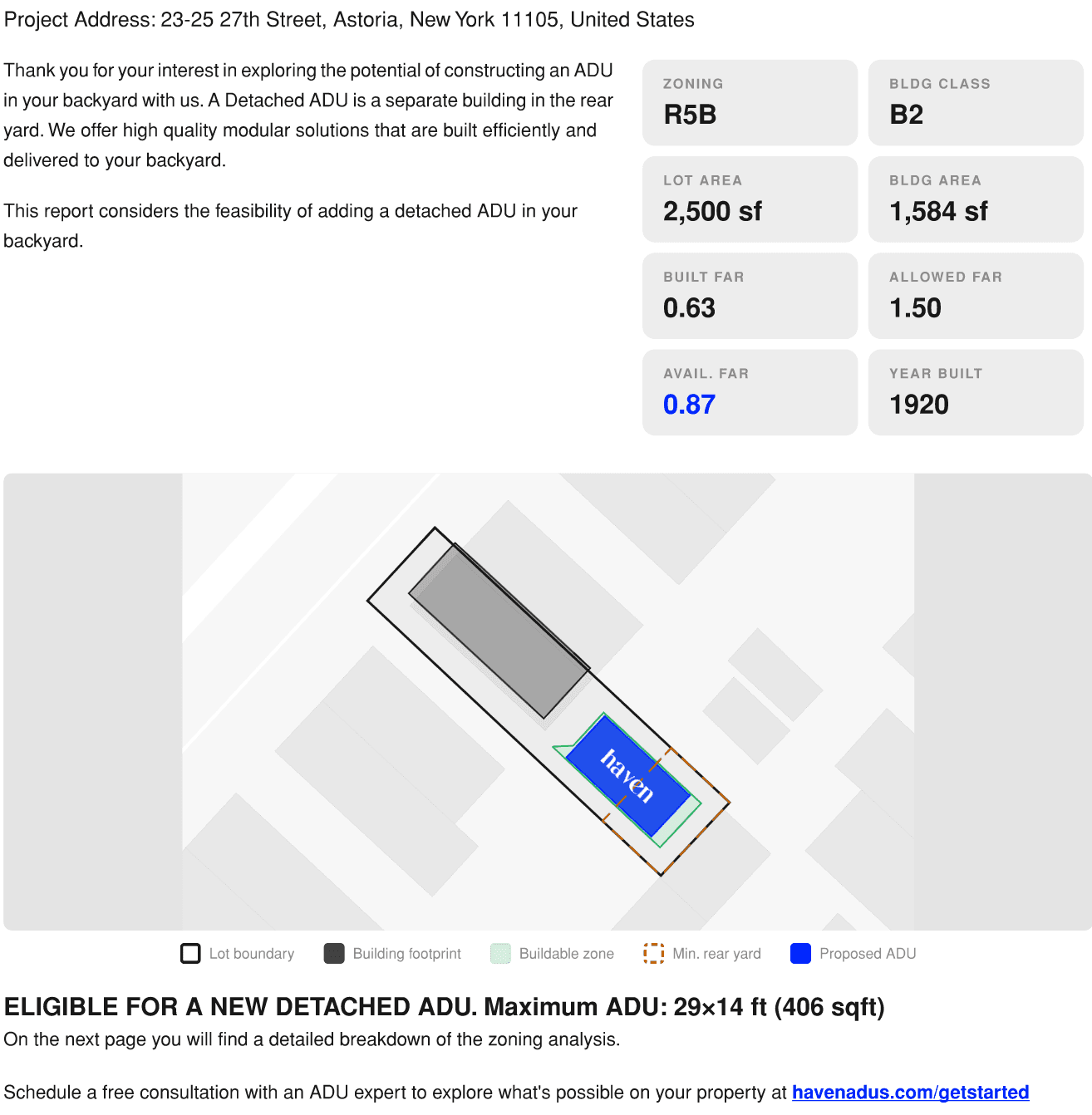
Figure 1: Haven feasibility report for 23-25 27th Street showing the property summary and color-coded site plan.
This is a typical Astoria lot: narrow (25 feet), deep (100 feet), with a 1920s brick two-family home. It's the kind of property thousands of Queens homeowners live on. Let's see how it scored on each check.
Part 1: NYC Zoning Checks — Does Your Property Qualify at All?
These six checks are pass/fail. If your property doesn't pass any of them, a detached backyard ADU is either not permitted or requires additional review. These are the checks that determine whether the conversation even starts.
Check 1: One or Two Family Dwelling
What it checks: Is the property classified as a one- or two-family home? City of Yes only permits ADUs on these property types. Three-family homes, multi-family buildings, condos, and co-ops are not eligible.
✅ Astoria example: Building class B2, which qualifies. This is a two-family dwelling. |
Check 2: Restricted Zoning
What it checks: Is the property in a zoning district that restricts detached ADUs? Most residential zones (R1 through R5, and some R6 through R10 districts) are eligible. However, certain low-density districts outside the Greater Transit Zone have restrictions.
✅ Astoria example: Zone R5B is not restricted. R5B is contextual residential zoning designed to preserve neighborhood character, but it is fully eligible for ADUs. |
Check 3: Historic District
What it checks: Is the property within a designated NYC Landmarks Preservation Commission (LPC) historic district? Properties in historic districts require LPC review for exterior alterations, which adds time, cost, and uncertainty to any new construction.
What a flag means: A historic district designation doesn't necessarily prevent the project, but it means your ADU design must go through LPC review in addition to DOB permitting. Expect additional months and design constraints.
✅ Astoria example: No historic district or landmark designation. Clear. |
Check 4: FEMA Special Flood Hazard Area
What it checks: Is the property in a FEMA-designated Special Flood Hazard Area (the 100-year floodplain)? Properties in these zones face strict flood-resistant construction requirements: elevated foundations, flood-proofing, and specific materials.
What a flag means: Being in a FEMA flood zone doesn't disqualify you, but it significantly increases construction costs and design complexity. The ADU may need to be elevated above the Base Flood Elevation (BFE), which affects access, design, and budget.
✅ Astoria example: Not in a FEMA Special Flood Hazard Area. |
Check 5: Coastal Flood Risk Area
What it checks: Is the property in a coastal erosion or flood risk zone? This is separate from FEMA mapping and applies to properties near the NYC waterfront.
Where this matters most: Properties in the Rockaways, parts of Staten Island's south shore, Coney Island, and sections of the Bronx waterfront. Inland properties almost always pass this check.
✅ Astoria example: No coastal flood risk designation. |
Check 6: DEP 10-Year Flood Risk Area
What it checks: Does the property fall within the NYC Department of Environmental Protection's Interim Flood Risk Area maps? These are newer, more granular flood risk maps that supplement FEMA's data and cover areas subject to stormwater flooding.
What a flag means: A yellow flag here doesn't mean the property is in a flood zone. It means manual verification is required. Haven's team handles this verification during the consultation phase.
⚠️ Astoria example: Yellow flag: Refer to "Interim Flood Risk Area" published by DEP. Manual verification required. |
Part 2: Geometry Checks — What Can Actually Fit on Your Lot?
If you've passed the threshold checks, your property is eligible in principle. Now the question becomes: what can you actually build? These seven checks analyze your lot's geometry and zoning capacity to determine the maximum ADU size and placement.
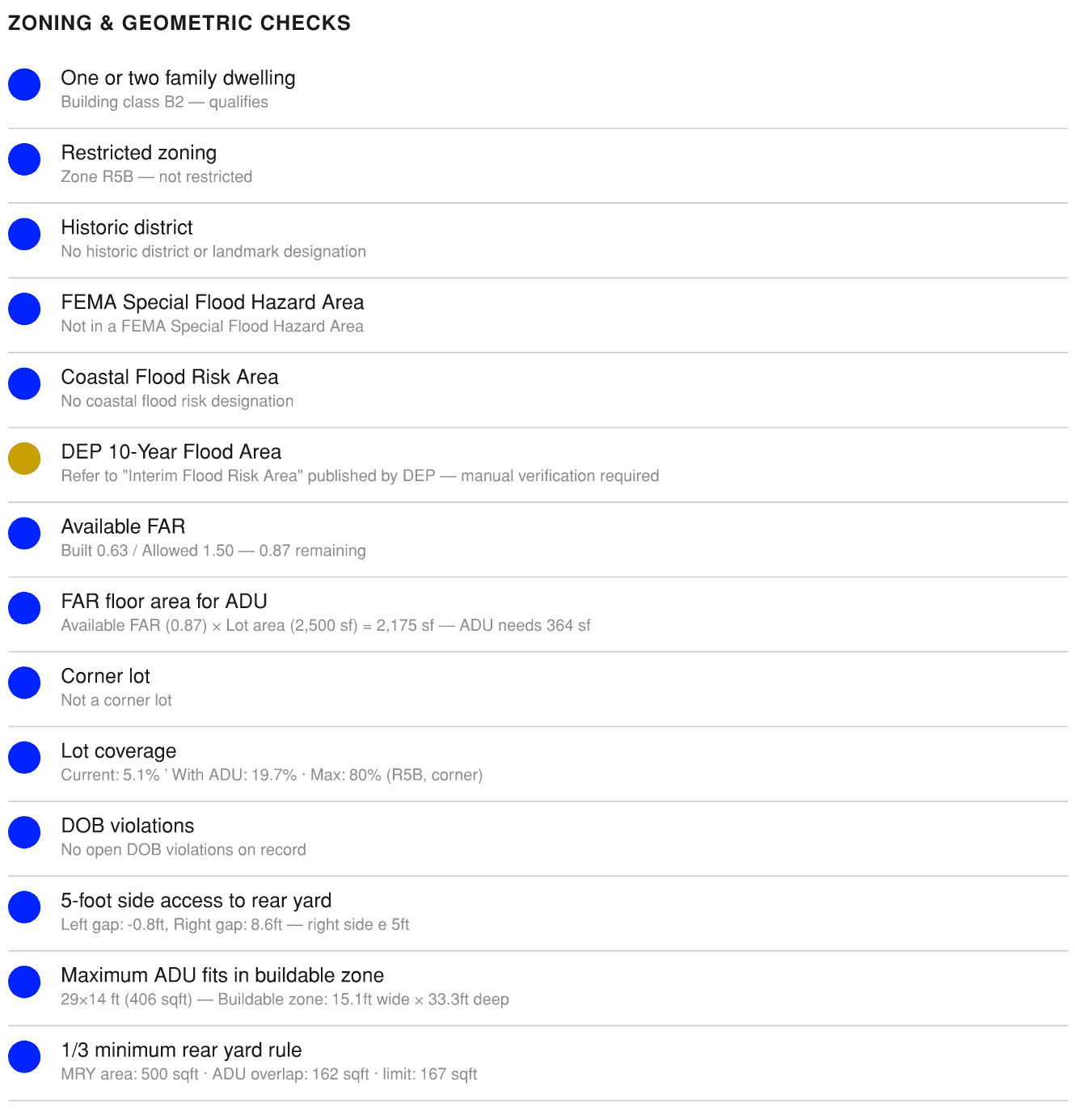
Figure 2: Haven feasibility report showing zoning and geometric check results for 23-25 27th Street.
Check 7: Available FAR (Floor Area Ratio)
What it checks: How much of your lot's allowed building capacity has already been used? Every zoning district has a maximum Floor Area Ratio (FAR), the total buildable floor area expressed as a ratio of lot size. If your existing building already uses all the allowed FAR, there's no room for an ADU.
The math: Available FAR = Allowed FAR – Built FAR. Then: Available FAR × Lot Area = maximum additional floor area. Your ADU must fit within this number.
✅ Astoria example: Built FAR 0.63, Allowed FAR 1.50, Available FAR 0.87. That's 0.87 × 2,500 sf = 2,175 sf of available capacity. The ADU only needs 406 sf. Passes with room to spare. |
💡 Why this matters: This is often the most important check for two-family homes. If the existing building is large relative to the lot, the built FAR may be close to the allowed maximum, leaving little room for an ADU. Single-family homes on the same lot size typically have more available FAR. |
Check 8: FAR Floor Area for ADU
What it checks: Does the available FAR provide enough floor area for a minimally viable ADU? The City of Yes requires a minimum of 364 sf for a detached ADU.
When this doesn't pass: If Available FAR × Lot Area is less than 364 sf, the lot cannot support a detached ADU under current zoning. This most commonly happens on very small lots or with large existing buildings.
✅ Astoria example: Available FAR (0.87) × Lot area (2,500 sf) = 2,175 sf. ADU needs 364 sf. Passes easily. |
Check 9: Corner Lot
What it checks: Is the property on a corner? Corner lots have different setback requirements because they have two street-facing sides. This affects where the buildable zone falls and how the rear yard is defined.
Impact on ADU size: Corner lots aren't disqualified, but the buildable zone calculation is different. In some cases, corner lot geometry actually provides more flexibility; in others, it's more constrained.
✅ Astoria example: Not a corner lot. Standard mid-block setback rules apply. |
Check 10: Lot Coverage
What it checks: What percentage of the lot is covered by buildings? Adding an ADU increases lot coverage. This check ensures the combined footprint of the existing building plus the ADU doesn't exceed the zoning district's maximum lot coverage.
The math: Current coverage + ADU footprint ÷ lot area = new lot coverage percentage. Must be below the district maximum.
✅ Astoria example: Current coverage: 5.1%. With ADU: 19.7%. Maximum allowed in R5B: 80%. Well within limits. |
Check 11: 5-Foot Side Access to Rear Yard
What it checks: Is there at least 5 feet of clearance on at least one side of the house to provide a path from the street to the rear yard? This is a City of Yes requirement for detached ADUs. You need a way to access the backyard without going through the main house.
This is the deal-breaker for many properties: On narrow lots (20 to 25 feet wide) with attached or semi-attached homes, both sides of the building may be too close to the lot line. You only need one qualifying side, but if neither side has 5 feet of clearance, the project cannot proceed as a detached rear-yard ADU.
✅ Astoria example: Left gap: -0.8 ft (no access). Right gap: 8.6 ft, which exceeds the 5-foot minimum. Only one side needs to qualify, and the right side clears it comfortably. |
Check 12: Maximum ADU Fits in Buildable Zone
What it checks: After applying all setbacks (5 feet from side and rear lot lines, 10 feet from the main house), what is the remaining buildable area? Haven calculates the maximum ADU footprint that fits within this zone.
How setbacks work: The buildable zone is the rectangle that remains after subtracting 5-foot side setbacks, 5-foot rear setbacks, and 10 feet of separation from the main house. On a 25-foot-wide lot, side setbacks alone reduce the width from 25 to 15 feet. The depth depends on the rear yard dimensions and the main house's position.
✅ Astoria example: Buildable zone: 15.1 ft wide × 33.3 ft deep. Maximum ADU: 29×14 ft (406 sqft). This is the largest ADU that fits within all constraints. |
💡 Why most ADUs aren't 800 sqft: The 800 sqft cap is a citywide maximum, but very few NYC lots can actually reach it. On a typical 25-foot-wide lot, the buildable zone width after setbacks is around 15 feet. Combined with the 1/3 rear yard rule (Check 13), the practical maximum is usually 350 to 500 sqft. That's still a very livable studio or small one-bedroom. |
Check 13: One-Third Minimum Rear Yard Rule
What it checks: Does the ADU's footprint overlap more than one-third of the required minimum rear yard area? Every lot must maintain a minimum rear yard (MRY). The ADU is allowed to sit within this yard, but it cannot cover more than one-third of the MRY area.
Why this is often the binding constraint: On narrow lots, this check, not the FAR or the buildable zone, is frequently what limits the ADU's size. The math can be tight, and even a few extra square feet of ADU footprint can push you over the limit.
✅ Astoria example: MRY area: 500 sqft. ADU overlap: 162 sqft. One-third limit: 167 sqft. The ADU uses 97% of the allowable overlap. Tight, but it passes. This is essentially the maximum ADU this lot can support. |
Part 3: Compliance Check
Check 14: DOB Violations
What it checks: Are there any open violations from the NYC Department of Buildings on the property? Open violations can delay or prevent new permit applications.
What to do if you have violations: Resolve them before applying for an ADU permit. Common violations include work without permit, failure to maintain, or expired permits. Most can be cleared with proper documentation and inspections. Haven can advise on the resolution path during the consultation.
✅ Astoria example: No open DOB violations on record. Clear to proceed. |
Reading the Site Plan: What the Colors Mean
Every Haven feasibility report includes a color-coded overhead map of your property. Here's how to read it:
Color / Element | What It Shows |
Black outline | Lot boundary, the legal edges of your property |
Gray fill | Building footprint, your existing home as recorded in city data |
Green area | Buildable zone, the area where an ADU is permitted after all setbacks are applied |
Dashed blue outline | Minimum rear yard (MRY), the required open space; the ADU can overlap up to one-third |
Blue rectangle (Haven logo) | Proposed ADU, the maximum ADU footprint that fits within all constraints |
Orange hatching | Areas of overlap between the ADU and other zones (visual reference) |
The site plan is a preliminary layout, not a final design. It shows the maximum envelope: the largest ADU that could fit. Your actual ADU may be smaller, depending on your design preferences and how you want to use your remaining yard space.
👉 Run your address now: Go to havenadus.com/eligibility, enter your property address, and get your free feasibility report within seconds. You'll see every check, your maximum ADU size, and a site plan. If your property qualifies, schedule a free consultation at havenadus.com/getstarted to discuss next steps. |
Frequently Asked Questions
Is the eligibility report free?
Yes. The Haven feasibility report is completely free. Enter your address at eligibility.havenadus.com and you'll receive your full report, all 14 checks, maximum ADU size, and site plan, at no cost.
How accurate is the report?
The report uses publicly available zoning and parcel data from NYC's official databases. It is a preliminary feasibility assessment, not a guarantee of permit approval. Final eligibility is subject to review by the NYC Department of Buildings. Items flagged yellow (like DEP flood risk) require manual verification, which Haven handles during the consultation phase.
Why does my report say my maximum ADU is less than 800 sqft?
The 800 sqft cap is a citywide maximum, but the actual size depends on your lot. Setbacks (5 feet from sides and rear, 10 feet from the main house), the one-third rear yard rule, and available FAR all constrain the buildable area. On a typical 25-foot-wide lot, the practical maximum is usually 350 to 500 sqft.
What if one of my checks doesn't pass?
It depends on which check. Some are hard stops (wrong building class, restricted zoning). Others are resolvable: open DOB violations can be cleared, and flood zone issues may require design modifications. Schedule a free consultation at havenadus.com/getstarted to discuss your specific result.
What data sources does the tool use?
Haven pulls from NYC Department of Finance (building class, lot area, FAR), Department of City Planning (zoning districts, historic districts), Department of Buildings (violations, building footprint), FEMA (flood hazard areas), NYC DEP (interim flood risk), and public parcel geometry data for lot dimensions and setback calculations.
Can I build an ADU if I have a three-family home?
No. City of Yes limits detached backyard ADUs to one- and two-family homes. Three-family homes, multi-family buildings, condos, and co-ops are not eligible for detached rear-yard ADUs under the current rules.