
NEW JERSEY
South Orange’s first ADU. A split-level reinterpreted for a family’s next chapter.
Sarah has lived in her South Orange split-level since the 1960s. When apartment prices made downsizing impossible, she and her family found another way: an attached ADU that lets Sarah age in place while her daughter and son-in-law take over the main house. Haven designed the Swoop ADU, a 750-square-foot, two-bedroom home connected through the existing garage. Its curved facade takes a cue from the split-levels on the block, making the addition feel both familiar and new. It was the first ADU permitted and built in South Orange.
LOCATION
South Orange
SQ. FT.
750
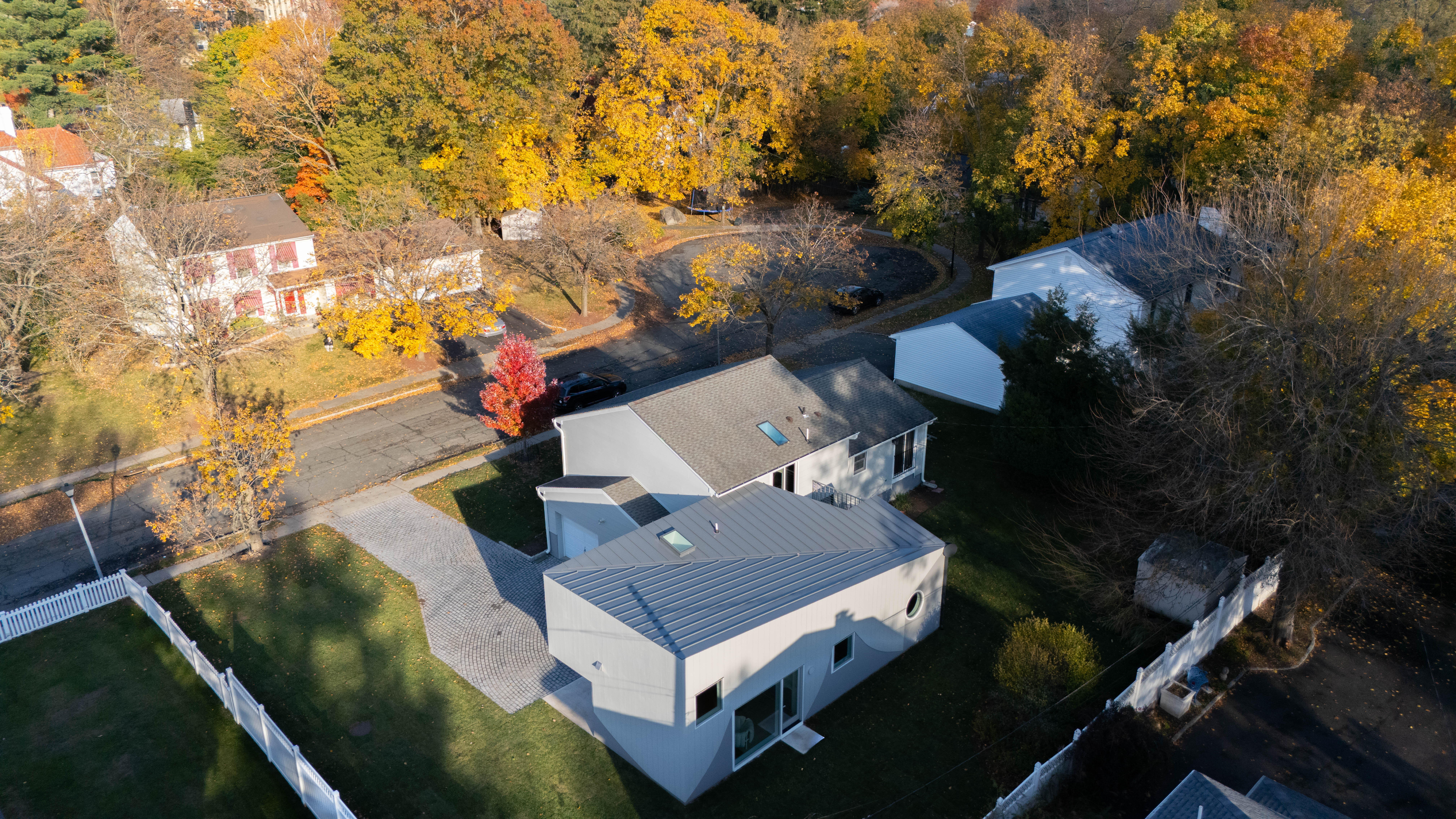
Sarah has lived in her South Orange split-level since the 1960s. The house sits within a cul-de-sac of nearly identical split-levels built around the same era, a neighborhood that has remained largely unchanged for decades. When Sarah began thinking about her next chapter, she wanted to stay on the property she knew. Downsizing into a nearby apartment or small single-story home seemed like the obvious path, but nothing on the market fit her needs or her budget.
Sarah’s daughter and son-in-law were ready to take over the main house. The family started looking for a way to let Sarah age in place in a home of her own while passing the larger house to the next generation. During their search, someone mentioned accessory dwelling units. South Orange, NJ was in the process of legalizing ADUs, and the timing lined up.
The family went to their local architect first, but the architect had no experience designing or permitting ADUs. They found Haven online and reached out. As an ADU design-and-build firm serving New Jersey and the tri-state area, Haven was able to take on the full scope: zoning research, design, the permit process, and connecting the family with vetted local builders. Sarah made it clear from the start that she wanted independence in this new home, but she was also open to something playful.
The site
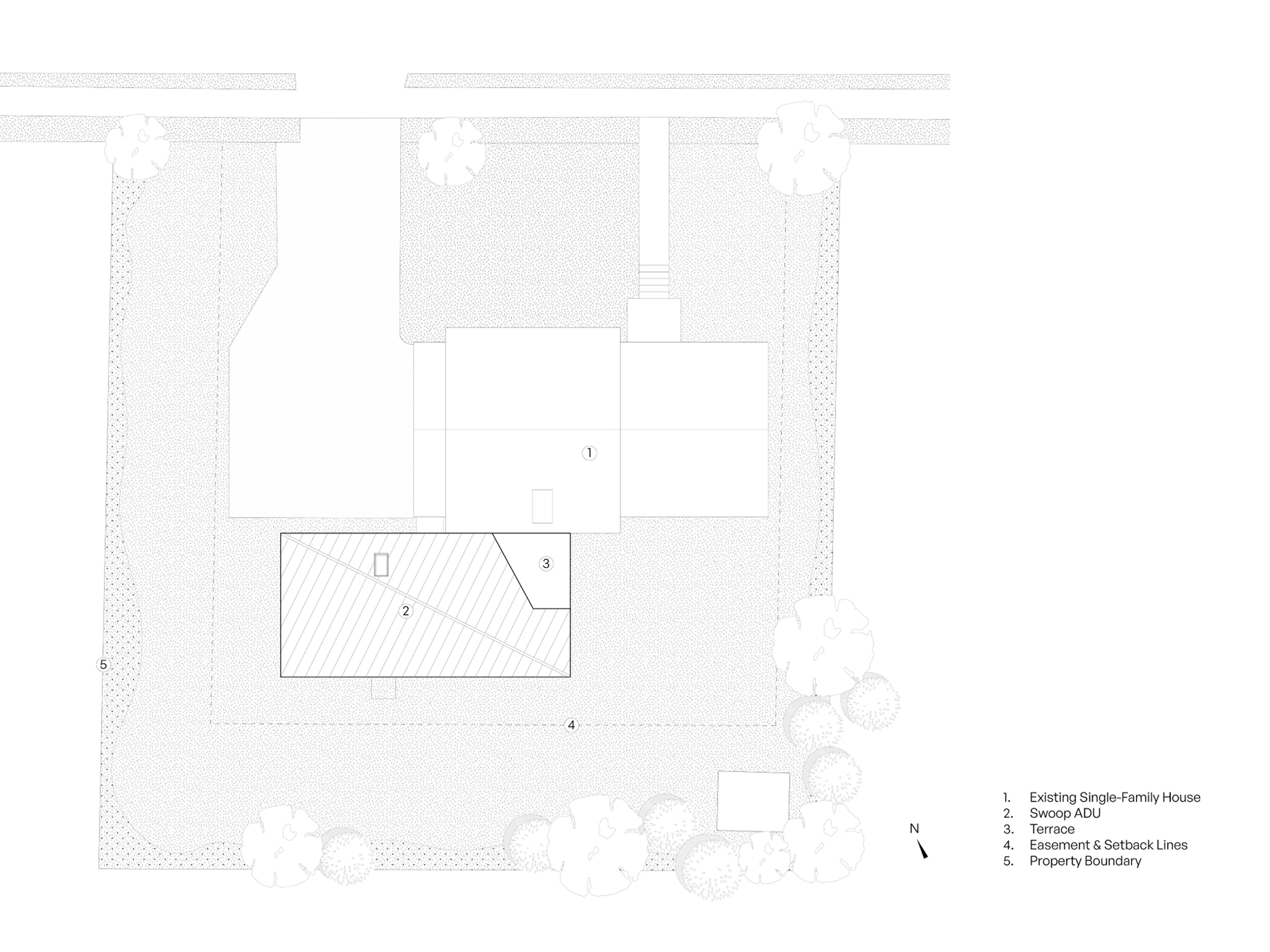
Site plan: 1. Existing single-family house 2. Swoop ADU 3. Terrace 4. Easement and setback lines 5. Property boundary
The Swoop ADU is attached to the back of the existing home, connecting through the family’s shared garage. This configuration kept the ADU within the building envelope allowed by South Orange’s new regulations while preserving the front-facing streetscape of the neighborhood. The backyard opens onto a new terrace that serves both the ADU and the main house, shared outdoor space that keeps the family connected without anyone giving up privacy.
Design decisions
Reading the split-level
The design started with the existing home. Split-levels from the 1960s typically have a two-material facade: something heavier on the bottom (stucco or brick) and siding on top. That material change creates a horizontal line that runs across nearly every house on the block.
In the Swoop ADU, that line gets a second life. Instead of running straight, it curves, dipping down around the front and back entries and rising to frame the windows. It’s a small move that ties the new structure to the old one while giving it its own personality. The ADU fits the neighborhood, but it doesn’t blend in.
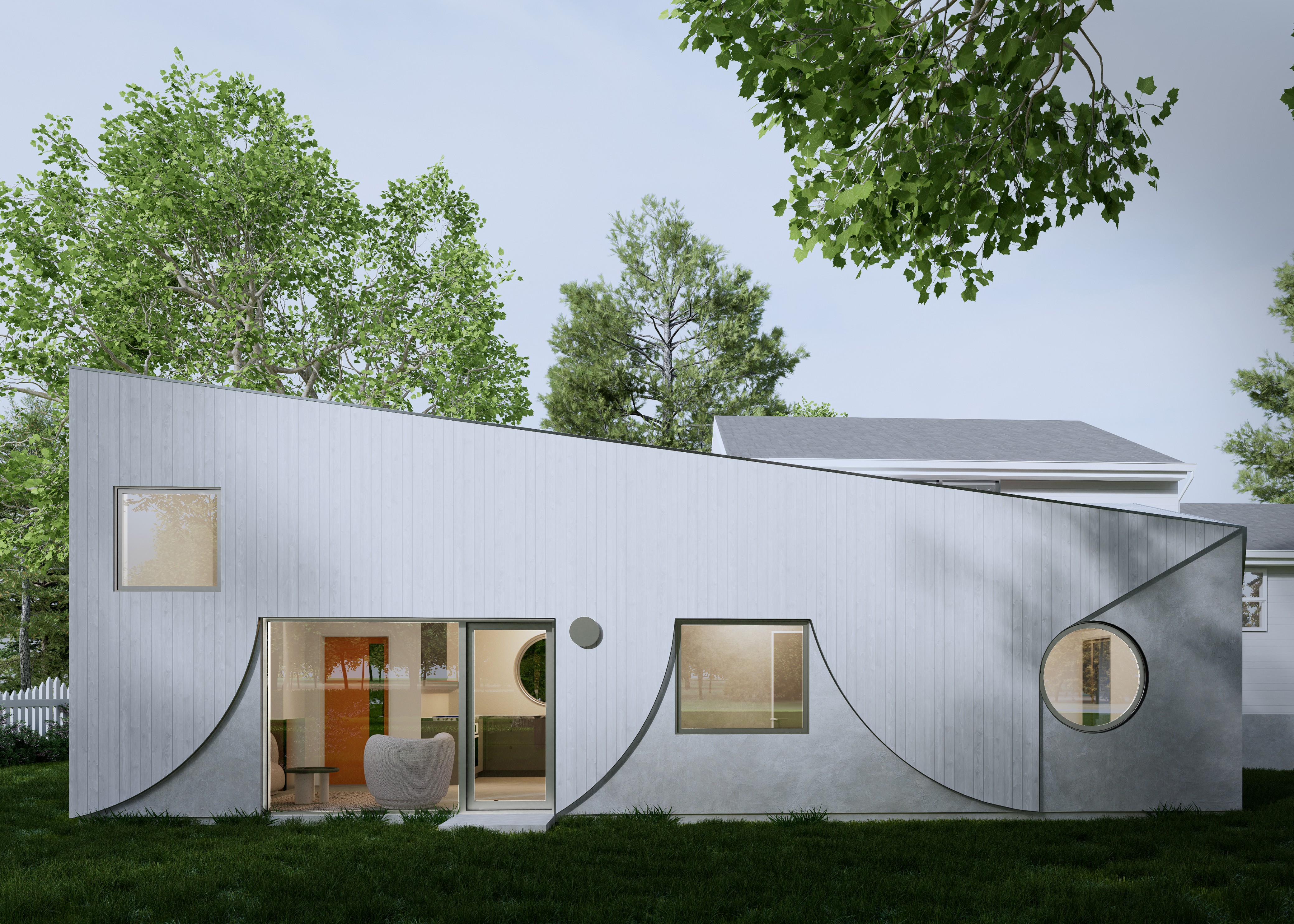
The back of the ADU: the curved line dips around the sliding doors and windows. The living area opens directly to the backyard.
Entry and layout
You enter through a small gabled porch that borrows a familiar roof shape from the surrounding houses. Inside, the space opens up quickly: a compact entry leads into a living room with 14-foot ceilings and a large picture window and glass patio door facing the backyard.
Inside
The curves from the outside carry into the interior. A custom built-in in the living room picks up on the same shapes, and the kitchen, with Reform cabinetry and gray terrazzo counters, wraps around a circular window that looks out toward the cul-de-sac. The primary bedroom is tucked into the quietest corner of the property, with privacy and views to the garden.
At 750 square feet, the layout makes the most of what it has. The two bedrooms are compact, but the living area feels generous thanks to the high ceilings and full-height sliding doors that open directly onto the backyard terrace.
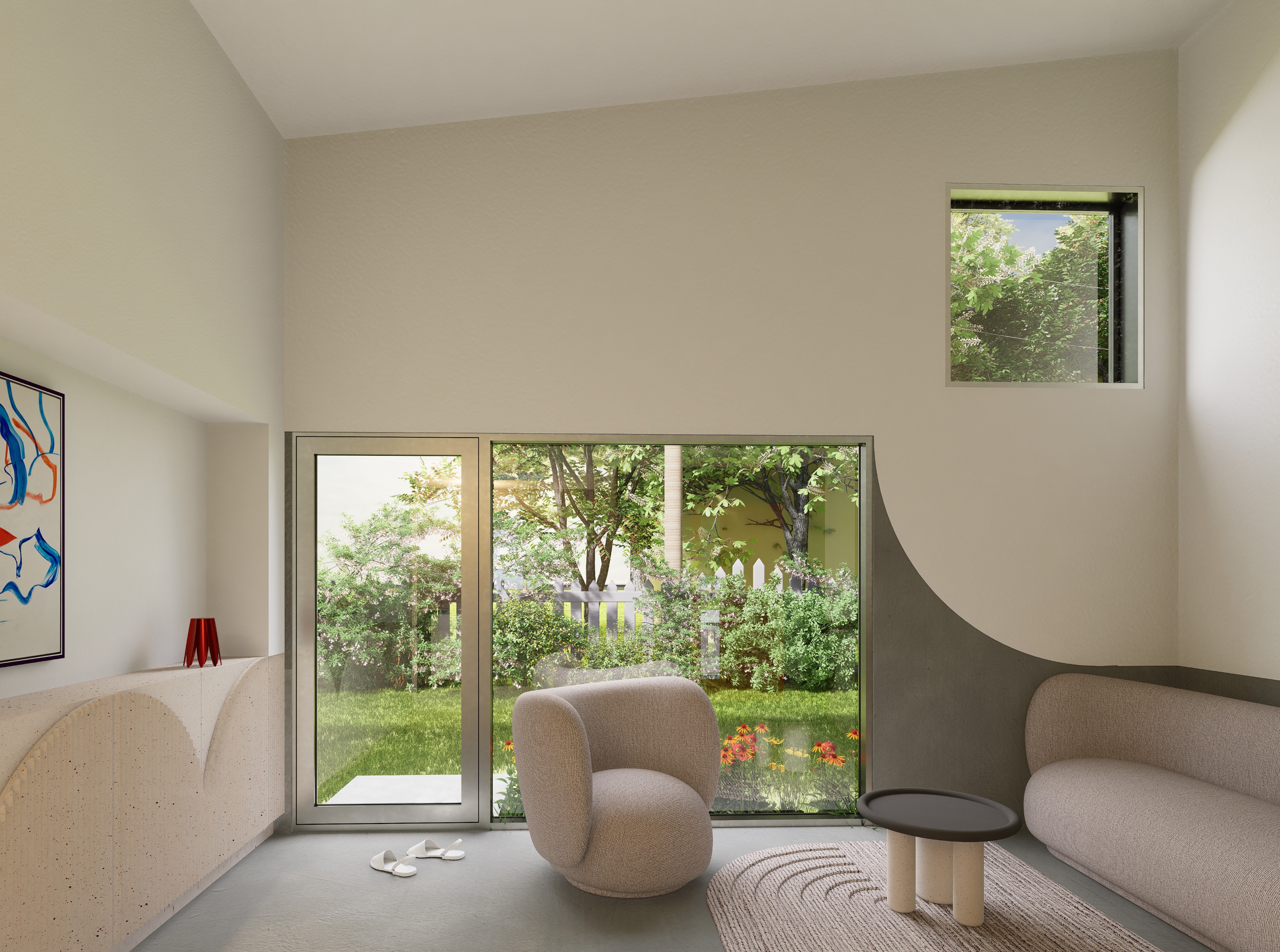
The living room: high ceilings, a clerestory window, and sliding doors to the backyard.
First in South Orange
The Swoop ADU was the first accessory dwelling unit permitted and built in South Orange. That meant navigating a regulatory process that was still being defined. Haven worked directly with the town throughout, from the initial zoning conversations through permitting, helping establish a path that future ADU projects in the municipality can follow.
At a construction cost of $325,000, the project delivered a complete two-bedroom attached ADU: kitchen, full bath, living area, and direct access to the shared backyard. For Sarah, it meant aging in place on the property she’d lived on for six decades. For her daughter’s family, it meant room to grow in the main house. For the municipality, it was proof that building an ADU in a New Jersey suburb can add housing without disrupting neighborhood character.
During construction, neighbors in the cul-de-sac grew curious about the new structure taking shape. It was something different from what they were used to seeing in new construction, and it offered a new way of living altogether.
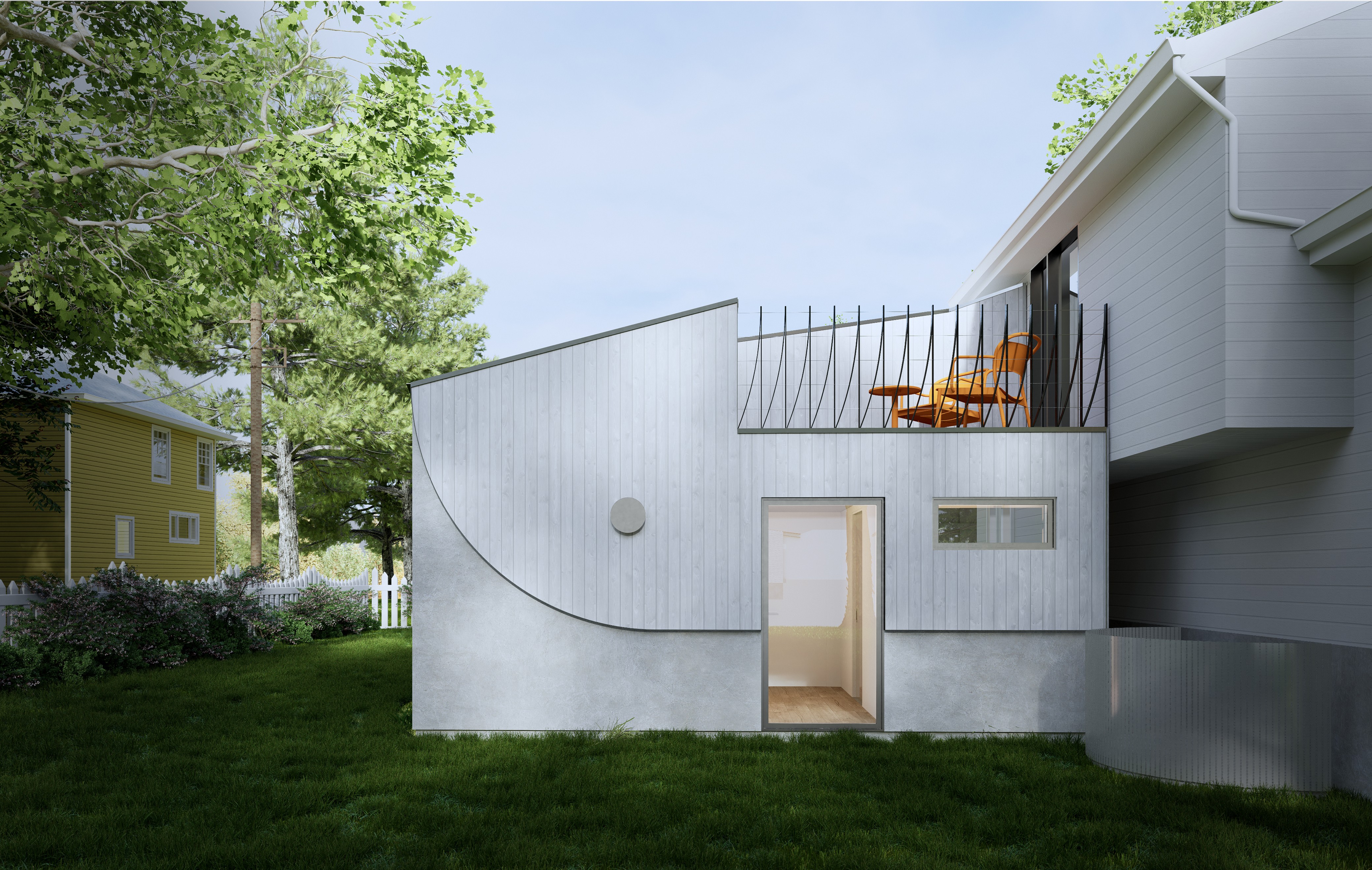
From the backyard: the ADU with its rooftop terrace. The existing split-level is to the right.
Living with it

The Haven team and Sarah on move-in day.
Sarah moved into the Swoop ADU while her daughter’s family settled into the main house. The backyard terrace, shared between both homes, has become the place where the family gathers. Close enough to see each other through the kitchen windows, far enough that everyone has their own front door. It’s multigenerational living on a single suburban lot, each generation with its own space and its own routine.
The Swoop ADU represents the next chapter in Sarah’s life. It also brought new energy to a neighborhood that had remained largely unchanged for decades. The property that held one household for sixty years now holds two, and the split-level that shaped a suburb got a second act.
Why build an attached ADU?
An attached accessory dwelling unit connects directly to the existing home, sharing a wall or, in this case, a garage. Attached ADUs are often more cost-effective than detached units because they can tap into the main house’s utilities and foundation. For families considering multigenerational living or aging in place, an attached configuration keeps everyone on the same property with separate entrances and fully independent living spaces.